What do TRUE, FALSE and NOT GIVEN mean?
What do TRUE, FALSE and NOT
GIVEN mean?
The most
important thing to remember is what the words ‘true’,
‘false’ and ‘not given’ actually mean and therefore what IELTS wants you to
write.
- If the text agrees with or confirms
the information in the statement, the answer is TRUE
- If the text contradicts or is the
opposite to the information in the statement, the answer is FALSE

·
If there is no
information or it is impossible to know, the answer is NOT GIVEN
True means that the meaning is the same. It is just similar then it
is FALSE. Remember
that we are dealing with factual information so there is no room to say it
is similar or nearly the same.
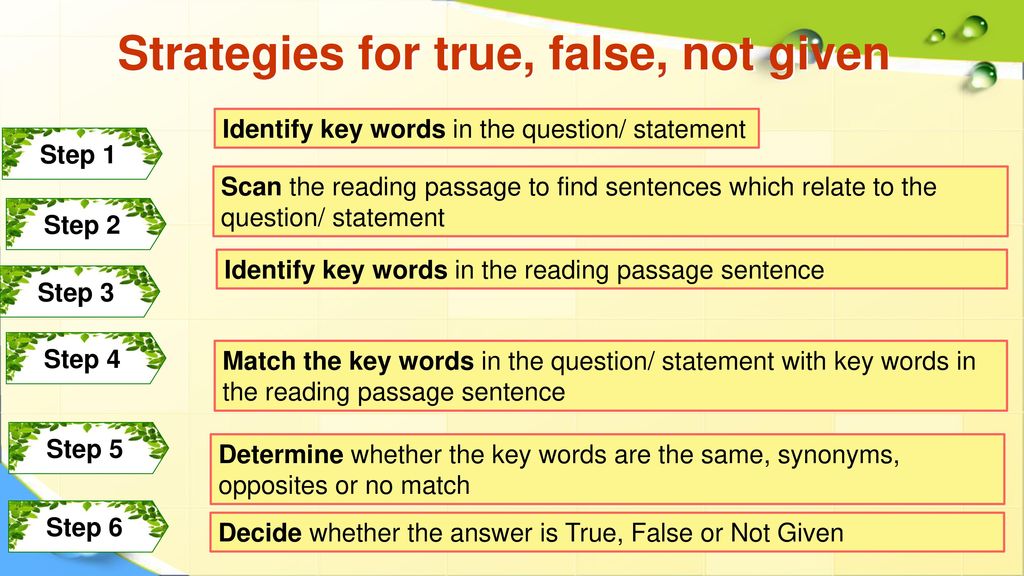
Steps to be followed to solve: True,
False, Not Given Questions
- Always read the instructions carefully and make sure you know if it is a TRUE/FALSE/NOT GIVEN or YES/NO/NOT GIVEN question.
- Read all the statements carefully, trying to understand what the whole sentence means rather than simply highlighting keywords. Watch out for qualifying words such as some or always. . These words are there to test if you have read the whole statement because they can change the meaning. For example, ‘Coca-Cola has always made its drinks in the U.S.A.’ has a different meaning from ‘Coca-Cola has mainly made its drinks in the U.S.A.’
- Be careful when you see verbs that
qualify statements, such as suggest,
claim, believe and know. For example, ‘The man claimed he was
a British citizen,’ and ‘The man is a British citizen’ mean two
different things.
- Try to think of what synonyms might
be in the text. This will help you identify the matching part of the text.
- Match the statement with the correct
part of the text.
- Focus on the statement again and then
carefully read the matching part of the text to establish if it is true or
false. Remember the meaning should exactly match that of the statement if
it is true.
- Underline the words that give you the
answer, this will help you focus and you can check back later. Again, be
careful there are no qualifying words in the text.
- If you can’t find the answer, mark it as ‘not given’ and move on to the next question.
- If you are really unsure or can’t find the answer, mark it as ‘not given’.
- YES/NO/NOT GIVEN questions are slightly different because they deal with opinion. TRUE/FALSE/NOT GIVEN questions deal with facts.
Important:
In IELTS exam,
following the instructions is important. You need to write the
answer in the format they have mentioned in the instructions. So, if you are
instructed to write TRUE then you should write TRUE and
if you have written T then your answer will be
marked incorrect as it is not according to instructions.


Comments
Post a Comment